
Skin claims
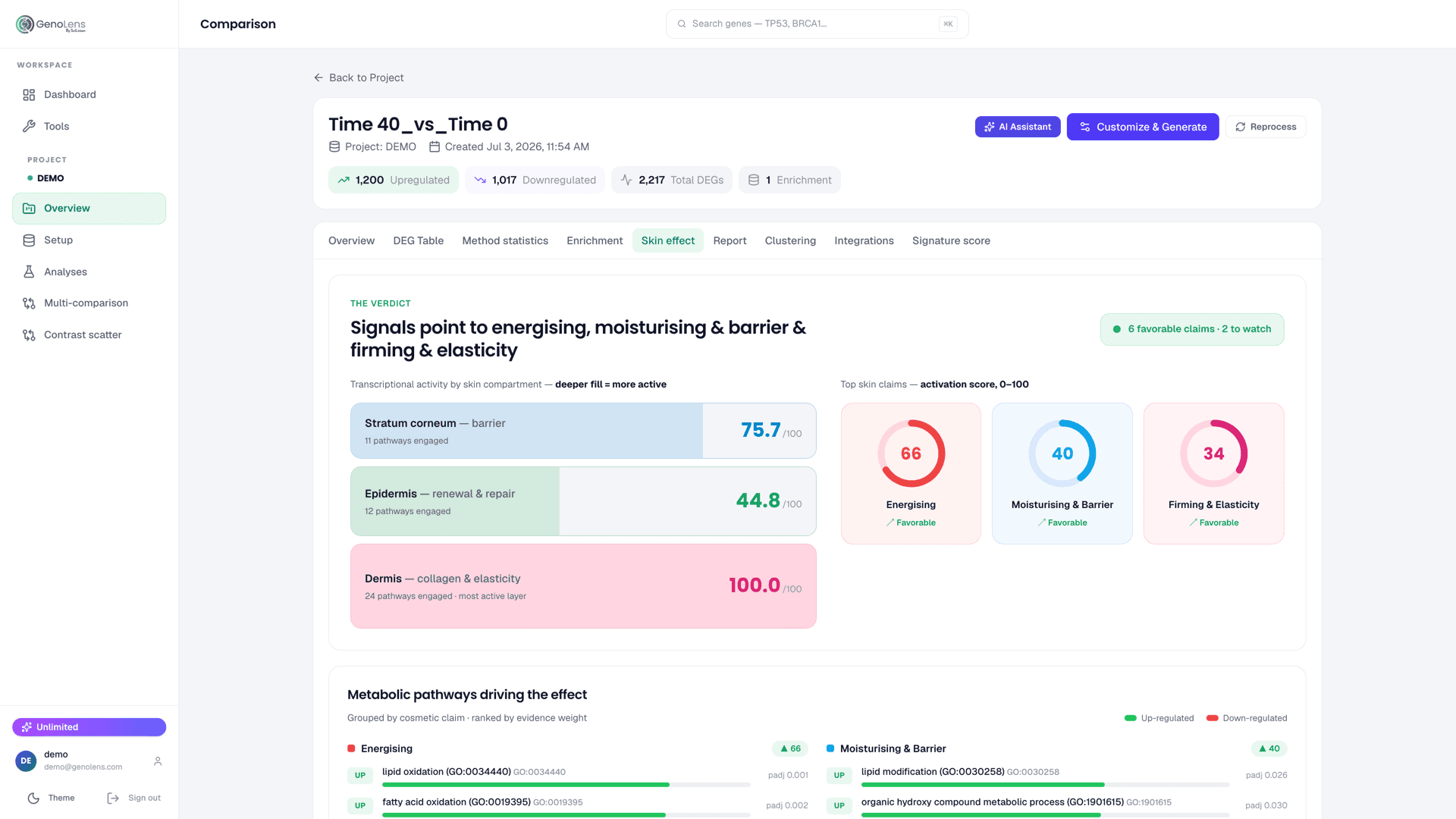
Turn differential expression into scored cosmetic claims. Maps the enriched pathways of a comparison onto a curated cosmetic claim referential, scoring nine claims and seven skin compartments from your own transcriptomics evidence.
Pricing on request · billed annually · works with Starter, Pro and Enterprise
Why it exists
The gap between a pathway list and a claim
A cosmetics R&D team finishes an enrichment analysis with a list of two hundred significant GO and Reactome terms. Somewhere in that list is the answer to the only question marketing will ask: does the active do what we want to say it does? Bridging that gap is manual, slow, and different every time somebody does it.
This module does the bridging in a fixed, inspectable way. Enriched pathways are joined against a curated referential that maps pathways to claims, and the result is a score per claim and per skin compartment — with the pathways that produced it kept attached, so the reasoning survives contact with a reviewer.
Two signals, deliberately kept apart
A claim score is directional: it only rises when the observed regulation matches the direction that supports the claim. Compartment activity is non-directional: it measures how much of the biology of that skin layer is engaged at all. Keeping them separate is what stops a strongly perturbed compartment from being read as a favourable result.
- Claim score 0–100, each labelled favourable or unfavourable
- Compartment activity across the seven layers of the Skin Stack
- HIGH / MODERATE / LOW confidence on every claim
- The pathways driving each claim, ranked by evidence weight
- An AI verdict summarising the read, and a marketing-facing summary
Nothing in the score is a black box
Every enriched pathway that matches the referential contributes weighted evidence. The weighting is explicit and the same for every comparison.
01
Match
Enriched pathways are normalised — GO, Reactome and KEGG accessions — and joined against the curated claim referential.
02
Weight
Each match carries an evidence weight from the referential, multiplied by a significance factor derived from −log₁₀(padj) and capped at ten.
03
Saturate
Accumulated evidence is passed through a saturation curve, so ten weak pathways cannot outvote two strong ones.
04
Qualify
Confidence is HIGH with two high-evidence pathways, MODERATE with at least two supporting pathways, LOW otherwise.
What a score is, and is not
A claim score is a structured reading of your own transcriptomics evidence, with the pathways behind it kept attached. It is a tool for prioritising and for substantiating an internal argument — it is not a regulatory assessment, and it does not by itself make a marketing claim defensible. Clinical and instrumental evidence remain your responsibility.
Nine claims
A fixed vocabulary, so two studies a year apart are scored the same way and can be compared. Each claim is anchored to the skin compartment its pathways belong to.
Anti-ageing
Cellular resilience & ageing
Supports cellular resilience, proteostasis and DNA integrity associated with younger-looking skin.
Anti-wrinkles
Dermis
Targets the dermal matrix mechanics linked to fine lines and wrinkles.
Firming & Elasticity
Dermis
Reinforces extracellular matrix, adhesion and cytoskeleton for firmer, more elastic skin.
Regenerating & Renewal
Epidermis
Stimulates turnover, protein synthesis and cellular trafficking for skin renewal.
Moisturising & Barrier
Stratum corneum
Supports barrier lipid synthesis and organisation for better hydration and TEWL control.
Soothing & Anti-redness
Inflammation
Modulates inflammatory and eicosanoid signalling to calm redness and irritation.
Antioxidant & Detox
Antioxidant defence
Reinforces redox defences and detoxification against oxidative stress.
Energising
Cellular energy
Boosts mitochondrial and metabolic activity for energised skin cells.
Healing & Repair
Epidermis
Promotes wound-healing and tissue repair processes.
Seven compartments, read as one section through the skin
Alongside the claims, activity is aggregated per compartment and drawn on an annotated schematic — deeper fill means more of that layer’s biology is engaged. It answers a different question from the claims: not “does it work”, but “where is it acting”.
- 01Skin barrier (stratum corneum)
- 02Epidermis (renewal & repair)
- 03Dermis (collagen & elasticity)
- 04Inflammation & redness
- 05Antioxidant defence
- 06Cellular energy
- 07Cellular resilience & ageing
What it needs
A comparison with a completed enrichment run.
The Skin effect tab is visible on every account and ships a worked demonstration, so you can see the output on real data before enabling it. See how cosmetics teams use the platform end to end on use cases.
Other modules
Modules combine — each one adds to the same comparison
Talk to us
Score your next active against nine claims
Bring a comparison you have already run. We will show you the skin read on your own data before you commit to anything.